 USD
USD  GBP
GBP  CAD
CAD  AUD
AUD 
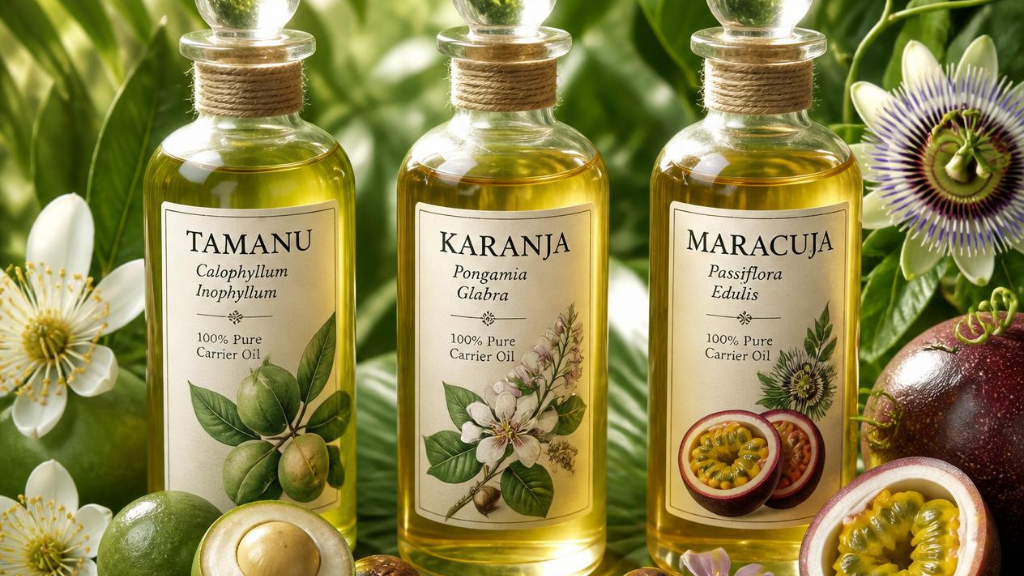
What Makes an Oil a Carrier Oil
A carrier oil is a plant-based fatty oil pressed from seeds, nuts or kernels. It is used to dilute concentrated essential oils so they can be applied to skin safely. Unlike essential oils, carrier oils do not evaporate and have little to no strong aroma of their own.
For a business, carrier oils matter more than most sellers realize. They are the base of nearly every body oil, balm, salve, scrub and hair oil on the market. The carrier is most of the bottle. It decides how your product feels, how long it lasts on the shelf, and what it costs you to make.
Here is the problem worth solving instead. Most sellers reach for coconut, jojoba and sweet almond. Those shelves are crowded, and customers price-compare them in seconds. The five oils below are far less common, which makes them much easier to build a distinctive product line around.
Tamanu Oil
A thick, green-gold oil used in small amounts for leave-on skin products, tamanu oil comes from the seeds of Calophyllum inophyllum, a tropical tree found across Asia and Australia.
The processing story is worth telling your own customers. The nuts are cracked and the seeds removed, then sun-dried for one to two months so the oil develops inside them. Only then are they de-shelled, pressed and filtered. That long drying stage is a big part of why tamanu costs more than a common base oil, and it gives you something real to say on a product page.
Be ready for the color and the smell. Tamanu is thick, greenish-yellow, and has a strong nutty scent. Both carry through into a finished product, so plan around them rather than being surprised by them.
The oil is rich in oleic, linoleic and palmitic fatty acids. It has a long history of traditional use on skin, and researchers have studied it for skin-barrier support.
What tamanu oil is used for in products
Tamanu works best as a small part of a blend rather than the whole bottle. Good fits include balms, spot treatments, face oils and beard oils, all of which stay on the skin.
It blends well with lighter carriers, which cuts both the color and the scent while keeping the character of the oil.
The nut allergy issue every seller should know
Tamanu is classified as a tree nut oil. Anyone with a tree nut allergy should avoid it.
This is not just a personal-use warning. It is a labeling point. If you sell a balm or face oil containing tamanu, that information needs to be visible to the person buying it, not buried. A customer at a craft fair cannot read your ingredient list from across the table.
Skin irritation and allergic reactions to tamanu have been documented in medical literature, so patch testing matters more with this oil than with most. Tamanu is for external use only.
Karanja Oil
A neem-like oil with a milder smell, used at low percentages as an active, Karanja oil is cold pressed from the seeds of the pongam tree, Pongamia glabra, also called Indian beech. Ours is made in India.
Karanja is botanically related to neem and shares a lot of its character. The difference is the smell. Karanja is milder and nuttier. If you have ever tried to formulate with neem and given up because of the odor, karanja is the practical alternative worth testing.
It contains two flavonoid compounds that most plant oils do not have: karanjin, at roughly 2.2 percent, and pongamol, at under 1 percent.
Like neem, karanja is normally used at a controlled percentage inside a blend rather than as a standalone base. It also has a second life in agriculture and pet care as an insect repellent, which opens up a product category most beauty sellers never think about.
What the research says about karanja and UV light
Lab work shows that karanjin and pongamol both absorb UV light. Pongamol's chemical structure is similar to avobenzone, a recognized UVA filter, with reported absorption peaks around 350 nm and 250 nm.
That is what the research shows about the compounds. It is not a benefit claim about any finished product, and it should never be written as one.
Why you cannot call it sunscreen on your label
In the United States, sunscreen is a regulated over-the-counter drug category. Any product marketed with an SPF number, or as sun protection of any kind, has to meet FDA drug requirements. That means approved active ingredients and formal testing.
Karanja is not an approved sunscreen active. Putting "natural SPF" on a handmade body butter creates real regulatory exposure for a small business, and it puts your customers at risk if they rely on it.
Plenty of supplier blogs call karanja a natural sunscreen without qualification. Do not repeat that on your label or your product page. Describe the oil and its compounds factually and let the ingredient stand on its own. Customers who know karanja will recognize it. Customers who do not will trust you more for being straight with them.
Maracuja Oil
A light, fast-absorbing oil that suits people who avoid oils entirely or who find them too heavy on their skin; maracuja is cold pressed from the seeds of the passion fruit, Passiflora edulis, native to Brazil, Paraguay and Argentina. Ours comes from Brazil.
It is notably high in linoleic acid, which is why it feels so light and sinks in quickly compared with heavier oils. It also contains vitamin C and carotenoids including lycopene.
Light texture, faint fruity scent, fast absorption. Of the five oils here, maracuja is the easiest one to start with.
What maracuja oil works well in
Face oils, lightweight body oils, hair serums and leave-in products, anywhere a heavy oil would feel greasy.
It is a strong option for customers with oily or combination skin, the ones who tell you they never use facial oils because everything breaks them out.
Unlike tamanu and karanja, maracuja works as an everyday base rather than a small-percentage active. You can build a whole product around it.
A common mix-up worth clearing up
Passionflower leaf preparations have a long traditional history as calming teas and tinctures taken by mouth. You will see that history repeated on pages selling the seed oil.
They are two different products. The seed oil is pressed from the seeds and used on skin. Those traditional calming uses belong to the leaf, taken internally, and they should not be carried across to the oil.
This matters when you write your own product descriptions. Borrowing claims that belong to a different part of the plant is one of the fastest ways to end up with a product you cannot back up and could land you in hot water.
Amla Oil
A hair and scalp oil with deep roots in Indian hair care, amla oil comes from the Indian gooseberry, Emblica officinalis. It has been used in Indian hair care traditions for centuries. Ours is made in India and comes in three sizes.
Here’s a handy tip and something to look out for when buying: A lot of amla oil on the market is an infusion, meaning the fruit is steeped in a base oil such as sesame or coconut, rather than a cold-pressed seed oil.
Neither is wrong, but they are not the same product and they do not carry the same ingredient list. Check which one you are getting, because whatever is in the bottle has to appear on your label.
Amla is naturally high in vitamin C and antioxidant compounds. It has a distinctive color and scent that will show up in a finished product.
Where amla fits in a hair care line
Of the five oils here, amla is the strongest fit for hair and scalp products: pre-shampoo treatments, scalp oils, braid and locs oils, and hot oil treatments.
That matters commercially. Amla speaks directly to the natural hair market, where hot oil treatments and scalp oiling are already part of the routine. You are not asking anyone to try something unfamiliar. You are offering a better version of something they already do.
Amla has traditionally been used for conditioning, softening and scalp care. Keep your claims in that lane and you will stay on solid ground.
Emu Oil, and Why It Sits Apart
Emu oil is rendered from bird fat. It is not pressed from a plant, which means it is not a carrier oil in the strict sense, though it is used the same way and sits alongside them on most shelves.
It is high in oleic and linoleic fatty acids and absorbs into skin readily, which is why it has held a loyal niche for decades. It has traditionally been used on dry skin and scalp.
What this means for your labeling and your customers
Emu oil cannot go into a product marketed as vegan or plant-based. If you sell online, that will come up, and it will come up publicly.
Some customers seek emu oil out specifically. Others avoid it on principle. Either way they are going to ask, so decide your positioning before you stock it rather than after.
It is also the most expensive of the five. Build it into a higher-priced hero product where the cost is part of the story, rather than using it as a general-purpose base.
How These Five Compare
|
Oil |
Texture and absorption |
Scent |
Typical use rate |
Best product fit |
Notes for sellers |
|
Tamanu |
Thick, slow |
Strong, nutty |
Low, in a blend |
Balms, spot treatments, beard oils |
Tree nut allergen. Green tint carries through |
|
Karanja |
Medium, moderate |
Mild, nutty |
Low, in a blend |
Cleansing bars, scalp blends, pet and garden products |
Do not label as sun protection |
|
Maracuja |
Light, fast |
Faint, fruity |
Base oil or blend |
Face oils, hair serums, light body oils |
Shortest shelf life of the five |
|
Amla |
Medium, moderate |
Distinctive |
Base oil or blend |
Scalp oils, pre-shampoo and hot oil treatments |
Check whether it is an infusion or a pressed oil |
|
Emu |
Medium, fast |
Mild |
Base or hero ingredient |
Dry skin balms, scalp products |
Not plant-based. Highest cost of the five |
Maracuja versus argan
Both are light and fast-absorbing, and they feel similar on the skin. The difference is the market. Argan is crowded and price-shopped, so your customer can find it cheaper somewhere else in about ten seconds. Maracuja gives you a similar feel with a product story nobody else in your category is already telling.
Tamanu versus jojoba
These are not substitutes. Jojoba is the neutral, stable, everyday base you build on. Tamanu is a strong-character ingredient used in small amounts for what it brings. They work best together, not instead of each other.
Tamanu versus rosehip
Both show up in leave-on facial products. Rosehip is lighter with a shorter shelf life. Tamanu is thicker, more stable, and much more strongly scented. If your customer is scent-sensitive, rosehip wins. If you want an oil with real presence in a balm, tamanu does more.
Buying These Oils Wholesale
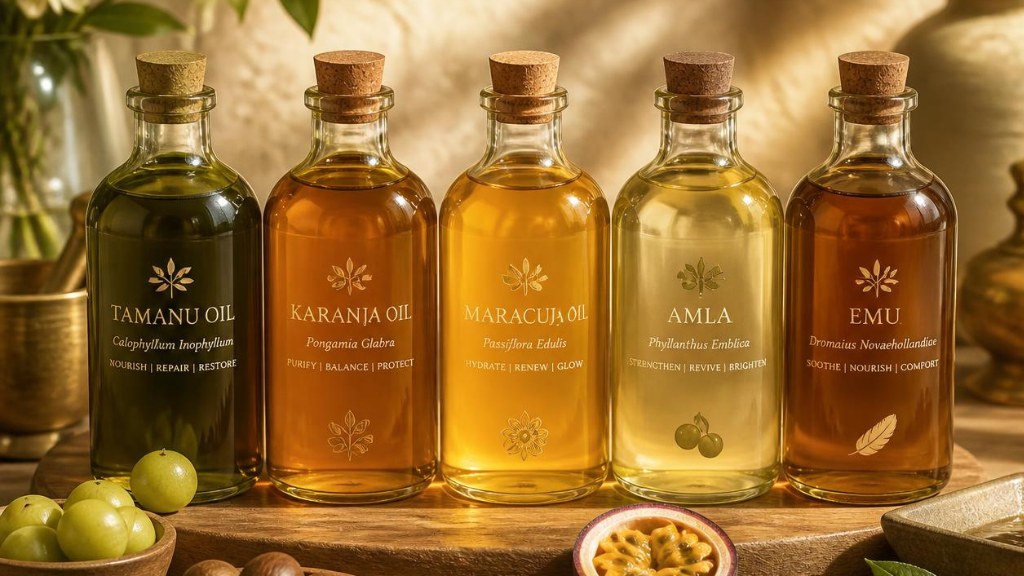
Cold-pressed versus refined
Cold pressing keeps more of the original compounds intact, and it is what buyers expect when they see the word unrefined. Refined versions are lighter in color and scent but lose some of the character that made you pick the oil. Whichever you use, say so in your product copy.
Shelf life
This varies a lot across the five. Karanja is one of the longer keepers at around two years. Maracuja is closer to one year. Buy sizes you will realistically work through before they turn.
Storage
Cool and dark, away from heat and sunlight. Bulk sizes decanted into smaller working bottles keep far better than one big container you open forty times.
Start small
All five are available in a 4 oz size. Test a formula at that size before you commit to larger volumes. Amla and emu are also stocked in 16 oz, and amla is available by the gallon once a formula proves itself.
Pricing and packaging these oils for resale
Repackaging
A 16 oz bottle fills roughly sixteen one-ounce retail bottles, allowing for a little loss along the way. One-ounce amber glass with a dropper is the standard format for a face oil, and it lets you offer a lower entry price than a full-size bottle.
Blend, do not just resell
Margin on a plain resold oil is thin, because your customer can price-compare it against every other listing. A blend you formulate yourself cannot be compared directly. Tamanu and karanja are ideal for this, because they are used at low percentages, so a small amount of an expensive oil stretches across a lot of units.
Label essentials
Ingredient list using INCI names, net weight, your business name and contact details, a batch number, and allergen information. The tamanu tree nut note belongs here.
Test in small batches first
Make a small quantity, use it yourself for two to three weeks, and watch for scent changes or separation before you scale anything up.
Positioning
An unfamiliar oil needs a reason to exist on your shelf. Do not just list it. Tell the customer what it does and why you chose it. That story is what justifies a higher price than a mainstream oil, and it is the part your competitors cannot copy.
FAQs
What is a natural carrier oil?
A natural carrier oil is a plant-based fatty oil pressed from seeds, nuts or kernels. It is used to dilute concentrated essential oils so they can be applied to skin, and it forms the base of most body oils, balms and hair oils.
What is tamanu oil used for?
Tamanu oil is used in leave-on skin products such as balms, face oils, spot treatments and beard oils. It is thick and strongly scented, so it usually goes into a blend at a low percentage rather than being used on its own. It is for external use only.
What are the top 10 carrier oils?
The most widely used are coconut, jojoba, sweet almond, apricot kernel, olive, argan, rosehip, grapeseed, avocado and sunflower. They are popular because they are mild, affordable and easy to find. Our complete carrier oils guide covers how to pick between them.
Can I use olive oil as a carrier oil?
Yes. Olive oil works as a carrier, though its scent can compete with whatever essential oil you add to it. Extra virgin is the usual pick for skin care. See our carrier oils guide for how it compares with lighter options.
What are the best carrier oils for anti-aging?
There is no carrier oil that will reverse skin aging, and no honest seller should tell you otherwise. Oils higher in antioxidants and fatty acids, such as maracuja and tamanu, are traditionally used in facial products for moisture and skin comfort. Keep your own product claims to what an oil does, not what it promises.
Is karanja oil the same as neem oil?
No, but they are close relatives. Karanja comes from the pongam tree and neem from the neem tree, and the two share much of the same character. The practical difference is smell. Karanja is milder and nuttier, which makes it easier to work with in products people wear.
Can I use maracuja oil on oily skin?
It is one of the better options. Maracuja is high in linoleic acid, which is why it feels light and absorbs quickly instead of sitting on the surface. Many people with oily or combination skin get on with it when heavier oils have not worked for them. Patch test first, as with any new oil.
How long do these oils last?
Roughly one to two years, depending on the oil and how you store it. Karanja sits at the longer end at about two years. Maracuja is closer to one. Store all of them somewhere cool and dark, and decant bulk sizes into smaller working bottles so you are not opening the main container repeatedly.
Health and Safety Disclaimer
These statements have not been evaluated by the Food and Drug Administration. These products are not intended to diagnose, treat, cure or prevent any disease. All oils described here are for external use only.
Always patch test on a small area before wider use, and stop using a product if irritation occurs. Tamanu oil is a tree nut oil and should be avoided by anyone with a tree nut allergy. If you have a skin condition or are pregnant or nursing, speak with a healthcare professional before using a new oil.
Add These Oils to Your Next Wholesale Order
All five are stocked in wholesale sizes, with low minimums and same-day shipping from our US warehouse. Start with a 4 oz bottle, test your formula, and scale up once you know it works.
And every order does more than fill your shelves. Over half of Africa Imports profits fund schools, medical care and skills training in Africa. That has been the reason this business exists for more than 25 years.